Age-related macular degeneration (AMD) is one of the leading causes of vision loss among older adults. It affects the macula, a small but extremely important part of the retina that is responsible for sharp central vision. Healthy central vision allows you to read, recognize faces, drive safely, use digital devices, and perform many of the everyday tasks that require fine visual detail.
Unlike many eye conditions that cause irritation or discomfort, macular degeneration often develops gradually and without pain. In its earliest stages, many people notice no obvious symptoms at all. As a result, changes to the retina can progress unnoticed until central vision begins to decline. This is why routine eye examinations are so important, especially as you get older or if you have risk factors for developing the condition.
A macular degeneration exam is designed to evaluate the health of your retina and detect even subtle changes that may not yet affect your vision. Identifying these changes early allows your optometrist to monitor your eyes closely, provide recommendations to support your eye health, and refer you for additional care if treatment becomes necessary.
Several factors can increase your risk of developing age-related macular degeneration, including:
- Age over 55
- Family history of macular degeneration
- Smoking or previous tobacco use
- High blood pressure
- Cardiovascular disease
- Obesity
- Long-term UV exposure
- Poor diet
- Previous retinal disease
Many people assume that blurred vision is simply a normal part of aging. While your prescription may change over time, central vision loss caused by macular degeneration should never be ignored. Scheduling regular retinal examinations allows your optometrist to distinguish between normal age-related vision changes and signs of retinal disease.
Some of the most common symptoms that may develop as macular degeneration progresses include:
- Blurred central vision
- Difficulty reading
- Distorted straight lines
- Trouble recognizing faces
- Reduced colour perception
- Dark or blurry spots in the centre of vision
- Increased need for brighter lighting
- Difficulty adapting between light and dark environments
These symptoms do not always mean you have macular degeneration, but they should always be evaluated promptly. Many retinal conditions share similar symptoms, making a comprehensive examination the best way to determine the underlying cause.
Regular examinations are especially valuable because they establish a baseline of your retinal health. Comparing future scans with previous images allows your optometrist to detect even very small changes that might otherwise go unnoticed. Early detection often provides more opportunities for monitoring and management before significant vision loss occurs.
YOUR MACULAR DEGENERATION EXAM
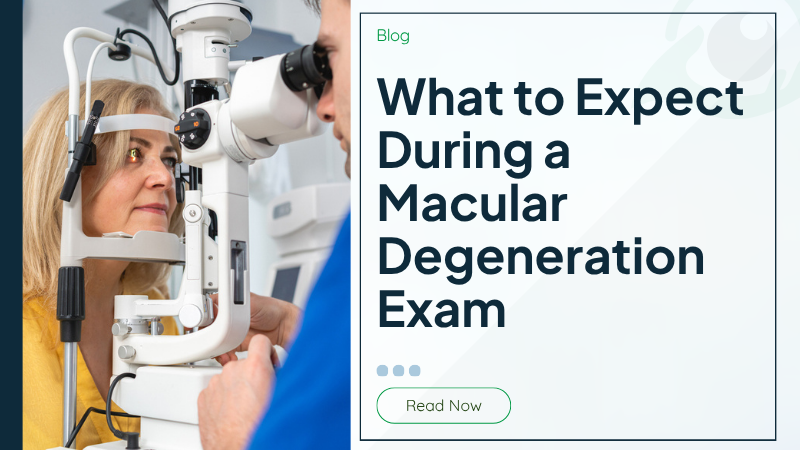
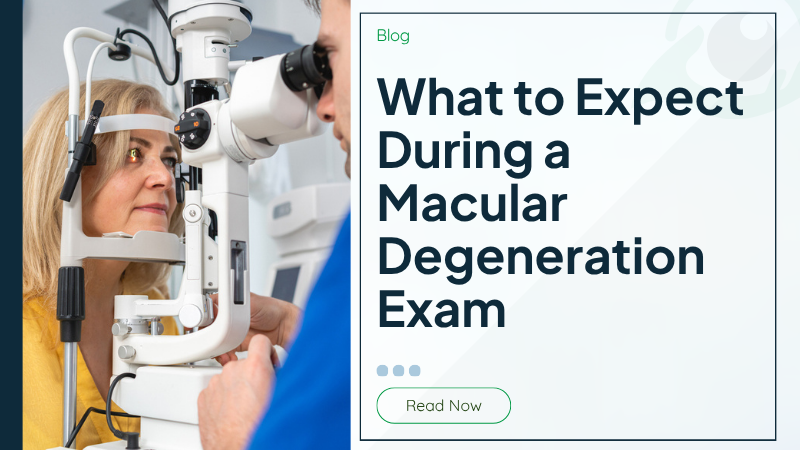
Many patients feel unsure about what to expect during a retinal examination, but the process is straightforward, comfortable, and completely non-invasive. A macular degeneration exam is designed to gather detailed information about the health of your retina so your optometrist can identify early changes and monitor them over time.
Your appointment usually begins with a discussion about your vision and overall health. Your optometrist will ask whether you have noticed any recent changes in your sight, particularly involving your central vision. They may also ask about your family history, current medications, smoking history, and medical conditions such as diabetes or cardiovascular disease, as these factors can influence retinal health.
You may be asked questions such as:
- Have you noticed blurry central vision?
- Do straight lines appear bent or distorted?
- Have colours become less vibrant?
- Do you have difficulty recognizing faces?
- Has reading become more difficult?
- Do you have a family history of macular degeneration?
- Have you noticed changes in only one eye or both?
Following your consultation, your examination begins with a series of tests that evaluate both your vision and the health of your eyes.
Your examination may include:
- Visual acuity testing
- Prescription assessment
- Retinal examination
- Macula evaluation
- OCT retinal imaging
- Dilated eye examination when appropriate
- Assessment of the optic nerve
- Review of retinal blood vessels
One of the most valuable technologies used during macular degeneration exams is Optical Coherence Tomography (OCT). OCT creates highly detailed cross-sectional images of the retina, allowing your optometrist to examine the individual retinal layers that cannot be seen during a standard eye examination alone.
These images help identify:
- Early retinal changes
- Macular thinning
- Retinal swelling
- Fluid beneath the retina
- Structural changes associated with AMD
- Progression since previous examinations
Unlike traditional imaging, OCT allows your optometrist to detect microscopic changes before they become visible through routine examination or begin affecting your vision. This makes it an invaluable tool for monitoring patients who have risk factors for macular degeneration or who have already been diagnosed with the condition.
Depending on your individual needs, your optometrist may also recommend dilating your pupils. Dilating eye drops temporarily enlarge the pupils, allowing a much wider view of the retina and macula. This provides additional information about the health of the back of your eye and helps ensure that no important findings are missed.
At the conclusion of your examination, your optometrist reviews your results with you, explains what was observed, compares your current findings with previous examinations when available, and discusses any recommendations for monitoring or additional care. Rather than simply telling you everything looks normal or abnormal, they help you understand the health of your retina and what it means for your vision moving forward. Different people experience macular degeneration differently, which is why ongoing monitoring is just as important as the initial diagnosis. Some patients remain stable for years with little change, while others develop more rapid progression that requires additional care. Comparing retinal images over time allows your optometrist to detect even subtle changes that may influence how often you should be monitored.
Your examination is also an opportunity to ask questions about your eye health. Many patients want to know whether their symptoms are related to macular degeneration, how frequently they should return for monitoring, and what lifestyle habits may help support long-term retinal health. By the end of the appointment, you should have a clear understanding of your retinal health, your level of risk, and any recommended next steps.
If early signs of macular degeneration are identified, your optometrist may recommend more frequent follow-up appointments to monitor progression. If more advanced changes are present, you may also be referred to an ophthalmologist for additional evaluation or treatment. The goal is always to detect changes as early as possible so appropriate care can begin before significant vision loss occurs.
Macular degeneration examinations are completely painless, and most testing is performed using non-invasive technology. Patients are often surprised by how comfortable the appointment is and how much information modern retinal imaging can provide. Even if your vision seems normal, these examinations play an important role in protecting your long-term eye health.
WHO NEEDS A MACULAR DEGENERATION EXAM?
Although anyone can develop retinal disease, macular degeneration is much more common as we age. Because the condition often develops slowly and without noticeable symptoms, many people do not realize they have it until central vision has already been affected. Routine eye examinations remain the most effective way to detect changes before they begin interfering with everyday life.
You should consider scheduling a macular degeneration exam if you:
- Are over the age of 55
- Have a family history of macular degeneration
- Smoke or have smoked in the past
- Have high blood pressure
- Have cardiovascular disease
- Have diabetes
- Notice changes to your central vision
- Experience distorted or blurry vision
- Have difficulty reading or recognizing faces
- Have not had a comprehensive eye examination in the last year
Even if you do not fall into one of these higher-risk groups, regular comprehensive eye examinations remain an important part of protecting your vision. Many retinal conditions share similar symptoms, and early diagnosis often leads to better long-term outcomes through timely monitoring and management.
Lifestyle also plays an important role in supporting retinal health. While not every case of macular degeneration can be prevented, healthy habits may help reduce your overall risk and support the health of your eyes over time.
Healthy habits include:
- Wearing sunglasses with UV protection
- Eating a diet rich in leafy green vegetables
- Maintaining healthy blood pressure
- Staying physically active
- Avoiding smoking
- Managing chronic health conditions
- Attending regular eye examinations
These habits work alongside regular professional care rather than replacing it. Your optometrist can monitor your retinal health over time and identify changes that cannot be detected at home.
At EyeCheck Calgary, we use advanced diagnostic technology to evaluate the health of your retina and monitor changes with precision. Every examination is tailored to your individual needs, allowing us to provide personalized recommendations based on your eye health, medical history, and risk factors. By identifying concerns early and monitoring your retinal health over time, we can recommend the most appropriate next steps to help preserve your central vision and support your long-term eye health.
Whether you live in Fairview, Willow Park, Southwood, Lake Bonavista, Oakridge, Ogden, Acadia, Crestview, Ranchlands, Rosemont, or elsewhere in Calgary, our experienced team is committed to providing thorough, patient-focused eye care. If you have noticed changes to your vision, have a family history of macular degeneration, or simply want peace of mind about the health of your eyes, contact EyeCheck Calgary today to schedule your comprehensive macular degeneration exam. Early detection remains one of the most important steps you can take to protect your vision and continue enjoying the activities that matter most.